In 2025, I donated $460k of stock toward causes I believe in and paid zero capital gains taxes! (And I also got a tax credit for the donation — but more about this later).
For context: we’re not “rich” by San Francisco Bay Area standards; however, by worldwide standards, we have an extreme level of privilege and wealth. Thanks to a few decades of hard work and luck (e.g. working at a gaming startup that sold to Disney), we have a decently-sized nest egg.
Why I Give Overseas
Traveling through Tanzania, Argentina, Peru, and Kenya in 2012–2016 showed me the gap in access to a healthy life and opportunity. Yet I also got to see how strong the human spirit is everywhere!

So, since 2017, my charitable goal has been simple: each person should have an equal chance at a healthy life, today.
To that end, each dollar goes further overseas.
In the US, even the most cost-effective medical interventions — smoking cessation programs1, generic statins2, hip replacements3 — cost roughly $1,000–10,000 to give someone another year of quality life. Most interventions cost vastly more, and in the US, we consider $100,000 for one extra year of life to be “cost effective.”4
Overseas, around $3,000–7,000 can give a young child an entire lifetime back. Children who survive these early childhood diseases have a strong chance of living into their 60s.
Why Not Just Pay Taxes?
I generally believe taxes do good, but I believe that every level of government (local, state, and federal) prioritizes a minority of their own voters too much over the rest of the world. This leaves gaps that I hope to help address.
Causes I Donated to in 2025
$430k → GiveWell All Grants Fund
GiveWell is one of my favourite charities because it has spent two decades working on directing money where it makes the biggest impact on human welfare.
I chose their All Grants Fund over their Top Charities fund because it gives GiveWell more flexibility — to direct money toward new research, emerging opportunities, and filling urgent gaps like those left by the collapse of USAID.
This year, they’ve been doing exactly that (funding cuts response, podcast). In 2024, their top charities each saved approximately one life for every $3,000–7,000 donated, and across all programs helped roughly 34 million people.
$15k → Defending Democracy in the US
New for me this year. Given authoritarian backsliding, I wanted to support organizations working on legal accountability, voting rights, and investigative journalism: Protect Democracy, ACLU, NAACP Legal Defense Fund, States United, and ProPublica.
$15k → San Francisco
With more dysfunction at the federal level, we have both more gaps and ability to act locally and at a state level.
So I also sent some money to local causes that have a high impact per dollar: tackling family homelessness, early childhood education, and economic mobility: Hamilton Families, Tipping Point, Wu Yee Children’s Service.
Giving Sustainably Through Financial Planning
One of the key things that helps me donate more is testing the limits of how much we can comfortably give as a family.
Before we got married, my life partner Joanna and I started financial planning together — It was my first introduction to cash-flow based planning that went beyond monthly budgeting and simple projections of investment growth.
The biggest benefit: you can test specific scenarios and see how they play out. What if we donated another $100k this year? Or we donated $20k more every year? What if our kid goes to an expensive college? What if we’re all funemployed for a few months?
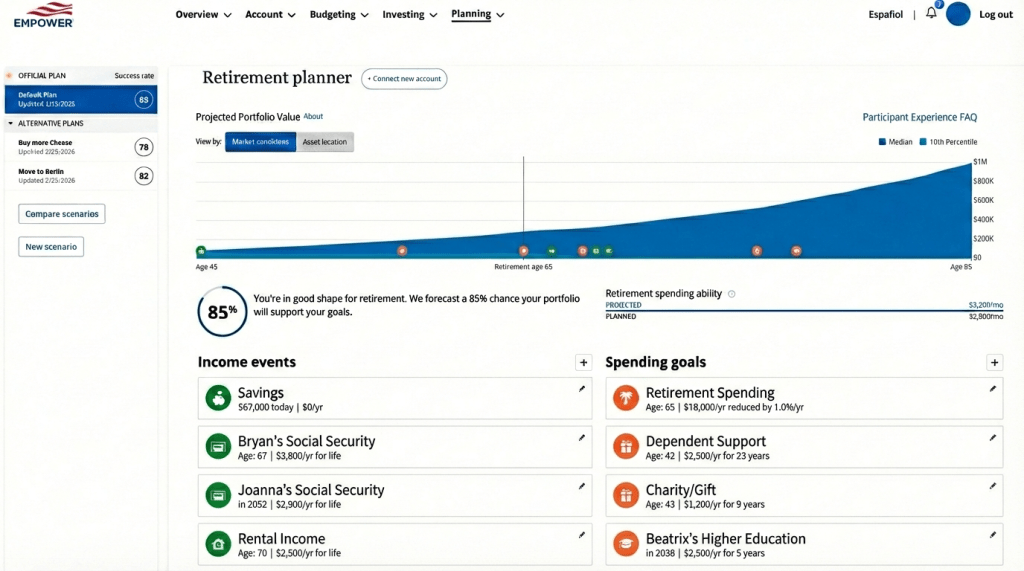
Tools like Empower, Boldin, and ProjectionLab let you model your probability of a comfortable retirement under each scenario. Then they run thousands of simulations of what the future might hold (i.e. Monte Carlo simulations) and give you a guess at your chance of “success” (usually defined as dying without running out of money).
Here’s what our Empower dashboard looks like — I’ve replaced all the real numbers with fabricated ones via Google’s Stitch tool:
Doing this planning together and revisiting it regularly help us to have grounded conversations about our priorities, risk tolerance, and capacity to give.
What’s Next
For the last decade, I’ve focused mostly on donating to improve human welfare internationally.
Going forward, Joanna and I plan to review our giving strategy:
- How do we give our time, expertise, and money most effectively?
- Are there other ways to donate money?
Should we donate cash, in addition to stock?
Are there high-impact ways to donate to 501(c)(4)s or PACs? - Are there other cause areas we care about beyond improving human welfare today?
- What is an appropriate balance between global, federal, and local giving?
- How can we contribute to awareness around inequality and what we can do about it?
If you’re thinking through similar questions, I’d love to hear what’s working for you.
Addendum: How A Donor Advised Fund (DAF) Works
A Donor Advised Fund lets you donate the full value of appreciated stock, without paying capital gains tax. When you transfer stock from your brokerage to your DAF, you can claim a tax credit for that tax year, up to 30% of Adjusted Gross Income (AGI). And then you can direct grants from your DAF to any registered 501(c)(3) charity.
Here are the basic steps:
- Setup a DAF
I use Vanguard Charitable as my DAF provider. For a comparison of providers: EA Forum comprehensive guide - From your brokerage, contribute stock to the DAF
Let’s say you bought the stock for $50k, and over the years, had 100% capital gains (grew by another $50k). In your brokerage account, there’s usually an easy way to ask to transfer shares of stock to your DAF. - Grant from the DAF
Any time after you contribute, you can grant money from the DAF to organizations you choose. Don’t forget to make a grant — money sitting in a DAF doesn’t help anyone! (I’ve forgotten to make grants a few times over the years :P) - At tax time
You don’t have to pay capital gains on the donated stock. You can use up to the full market value ($100k) as an itemized deduction — but this is capped at 30% of AGI for stock donations (60% for cash donations)
Sources
- Minian et al., “Cost-effectiveness of a smoking cessation intervention,” 2023. PMC10922402
- Lazar et al., “Cost-effectiveness of statin therapy for primary prevention in a low-cost statin era,” Circulation, 2011. AHA Journals — reports ~$9,900/QALY for broadest strategy; many strategies cost-saving at generic prices.
- Chang et al., JAMA, 1996 · Lavernia et al., 2018. JAMA · PubMed 29276115
- ICER, “2020-2023 Value Assessment Framework,” Section 3.9. ICER VAF (PDF) — operational cost-effectiveness threshold at ~$100,000–$150,000 per QALY.
- GiveWell cost-effectiveness model: New Incentives. Model
- GiveWell cost-effectiveness model: Malaria Consortium. Model
- GiveWell cost-effectiveness model: Against Malaria Foundation. Model · EA Forum derivation
- GiveWell cost-effectiveness model: Helen Keller Intl. Model
- GiveWell, “Life Expectancy in Sub-Saharan Africa.” GiveWell · World Bank Data
 Octoturtle Sabbatical